Lavender and pink pepper salt

After seeing the fields of lavender in bloom in the Provence in early summer, I started looking for reasons to use lavender in the kitchen. Creativity in cooking is often sparked by color. I believe that color has a powerful influence on taste. A jar of pink pepper corns in the cupboard inspired me to mix pink with purple in a bowl. I added fresh green leaves of rosemary to the brightly aromatic ingredients and put the bowl on a wooden tray as decoration.

ThreeBowls

I soon started to experiment with a new color composition. With the lavender fields of France in mind, I sprinkled some purple olives with the herbal mixture and left them to marinate in olive oil. I continued my taste and color studies with my beautiful bowl of herbs.
Continue reading

Saffron infused white wine vinegar

Saffron infused white wine vinegar
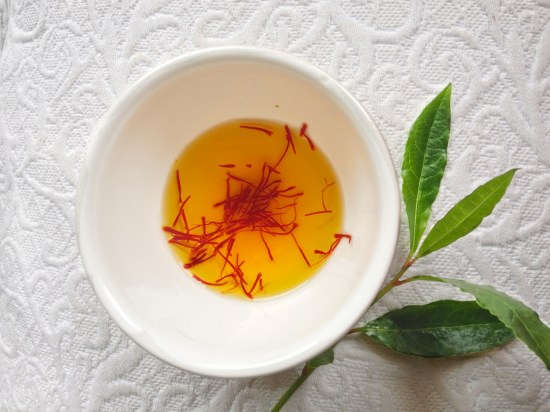
Saffron is a spice reminiscent of the ages. It is exotic and mysterious, a mixture of Asia and the Mediterranean, like Piazza San Marco and the Ponte Rialto of Venice.

The Venetian kitchen is interlaced with spices. Local vegetables and fish are marinated with ‘agro-dolce’ baths of warm vinegar, and allowed to mingle before being served on platters arranged on the time-worn wooden cupboards of ‘osterie’ tucked away in the narrow alleyways surrounding the fish market of this floating city.

The use of sweet and sour marinades is an inspiring kitchen technique, giving depth of flavor and color to the most basic of ingredients. The mineral-gold aroma of saffron is enhanced by white wine vinegar. Saffron infused vinegar is one of my favorite cupboard essentials.

Continue reading

Red chili pepper salt

Homemade red chili pepper salt gives flavor to the rustic dishes so typical of southern Italy. Like the dried red chili pepper flakes to be found in open-air markets, this cupboard essential is meant to be tossed over pasta with garlic and olive oil, sprinkled over melted mozzarella with oregano and mixed through salads of freshly cooked beans with marinated onions.

I happened upon the technique while looking for a means of saving too many fresh peppers. As often is the case with kitchen accidents, the result is out of the ordinary. While the juices of the peppers soak into the salt crystals, the sliced pepper rings dry slowly at low heat in the oven. The outcome is a grainy, bright red and spicy salt.

Continue reading

Yoghurt with olive oil and fresh dill

Yoghurt with lemon and olive oil blend interestingly into a simple dip. True to the Italian kitchen tradition, a delicious dish depends upon the quality and choice of ingredients. Use yoghurt that is so thick, it stays on your spoon. Squeeze an organically grown lemon. Pick bright green dill. Look for a fruity yet mild extra virgin olive oil. Use a clove of fresh spring garlic. Select an especially good salt. The resulting combination of creamy citrus is a match for grilled or marinated vegetables – is made to be poured over lettuces as a salad dressing – and is meant to be served in a big bowl as a dip for breads.

Continue reading

Homemade balsamic vinegar syrup


Aceto balsamico is one of the most widely used ingredients from the region of Reggio Emilia. It tastes sweet and tart. It goes well with the cheese most identified with Italy, namely the wonderfully grainy Parmigiano Reggiano.

Balsamic vinegar is created by simmering the freshly pressed juices and skins of locally grown grapes such as Trebbiano, Sangiovese and Lambrusco. The natural sugars in the grapes darken and thicken after undergoing an initial cooking process, thus becoming slightly caramelized. The liquid obtained slowly ferments, and is mellowed in casks made of the wood of chestnut, oak and cherry trees. For a period of years this darkish brown juice is moved from one wooden barrel to another.

Most experts agree that a minimum of three years is necessary to create that which is recognized as balsamic vinegar. The traditional vinegars of Modena and Reggio Emilia may be aged up to 25 years. They are reverently called a nectar, or at the very least a seasoning or condiment. An aged balsamic is treated like a perfume from heaven.

Continue reading

Orange infused honey


I cannot recall the first time I stirred the zest of an orange into a few spoons of honey. Perhaps it was in the period that I was experimenting with the elements of Sicilian pastries. Unable to find candied orange peel to mix through the ricotta and apricot filling for a tart, I put some orange zest into a jar of honey, imagining it to be a compromise. It turned out to be the contrary. The orange zest altered the color of the honey to a deep sienna almost immediately, infusing it with its vivid color. The sweet oils of the orange mingled through the honey, changing a primarily sweet flavor into a perfumed syrup. A few hours later the zest had changed consistency, turning into a clutter of threads. When left on the cupboard shelf, I discovered that the orange in the honey had caramelized completely. This made the simple combination of two ingredients even more fascinating in my mind. It meant that the orange zest could be used separately from the honey itself. Drizzled together over a bowl of raspberries or shavings of a crisp apple, orange-infused honey makes dessert appear to be a great effort, while it simply isn’t. A cupboard essential it is.

Continue reading

Red onion broth


One of the most interesting aspects of the Italian kitchen is its inventiveness. This recipe is based upon that very principle because it is made with the scraps of vegetables used for making a wintry tomato sauce or as a base for a root vegetable soup. Rather than get rid of the skins of the onions and the ends of the carrots, I cooked them with the tiniest bit of sea salt. The vegetable broth that came from this experiment is full of flavor and purely Italian in its creative simplicity. Enjoy this wonderfully deep-orange broth with pasta or rice. The necessity for broth cubes suddenly disappears when vegetable scraps are put to use!

Continue reading

Olio Nuovo

Oil

The ripened olives of Italy are gathered from their branches in the late fall. The olive harvest is pressed into oil in mid to late November, depending upon the place of origin. The first press of olive oil is celebrated throughout the country. New oil, or ‘olio nuovo’ is remarkable, dark green and rich in flavor and texture. There are no recipes required for its use, just the adequate matching of ingredients.

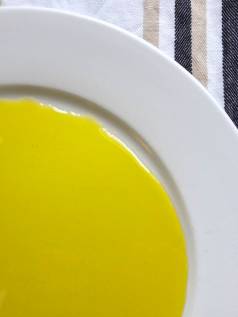
As the winter skies are grey and our surroundings are half asleep, pour some fresh, grassy olive oil on a plate and dream of summer.

Continue reading

Lemon-scented flour

Lemon-scented flour IIIf asked to choose the single most important ingredient in my kitchen, I would choose the lemon, first and foremost for the peel and secondly for its juice. The lemon is refreshing. On the island of Sicily the lemon is quite large and looks like a bumpy grapefruit. The Sicilian lemon is to be found on street markets throughout southern Italy. This citrus fruit is an integral part of Italian baking, and thus the lemon and its peel are a cupboard essential.


I discovered the method of infusing flour with lemon zest by chance. While planning ahead during a busy cooking schedule, I decided one day to put my freshly grated lemon peel into a jar filled with wheat flour. Hoping to infuse flavors slightly and to win time for the next day, I was surprised to discover in the morning that lemon peel had dried in the flour. I also found that the perfume of the lemon had permeated the entire jar. After sifting the flour to remove the dried lemon curls, I baked a cake topped with pine nuts. The result was subtle yet distinct. Since the success of my experiment, I keep a jar of lemon-scented flour in my cupboard.

Although you may not bake at home on a daily or even weekly basis, lemon-scented flour is perfect for pancakes, shortcrust pastry and even for pasta.

Continue reading

Red onions marinated in honey vinegar

RecipeWritings

My inspiration for the making of marinated red onions originates from the famous Venetian recipe ‘Sarde al Saor’. The traditional recipe for ‘sarde’ is made of a combination fried sardines in a bath of onions marinated in vinegar. Wandering through the streets of Venice, one will invariably find simple white ceramic platters filled with this combination of ingredients, set on buffet tables and bar counters, ready to be served with a glass of cold white wine. An Italian won’t mind the relatively colorless appearance of white onions on fried fish, served at room temperature on a credenza table top. Living far north of Venice, I found that my guests were reluctant to eat fried sardines, let alone white onions in vinegar. Thus the study of marinated onions that ultimately led to the simple recipe that follows.

Continue reading